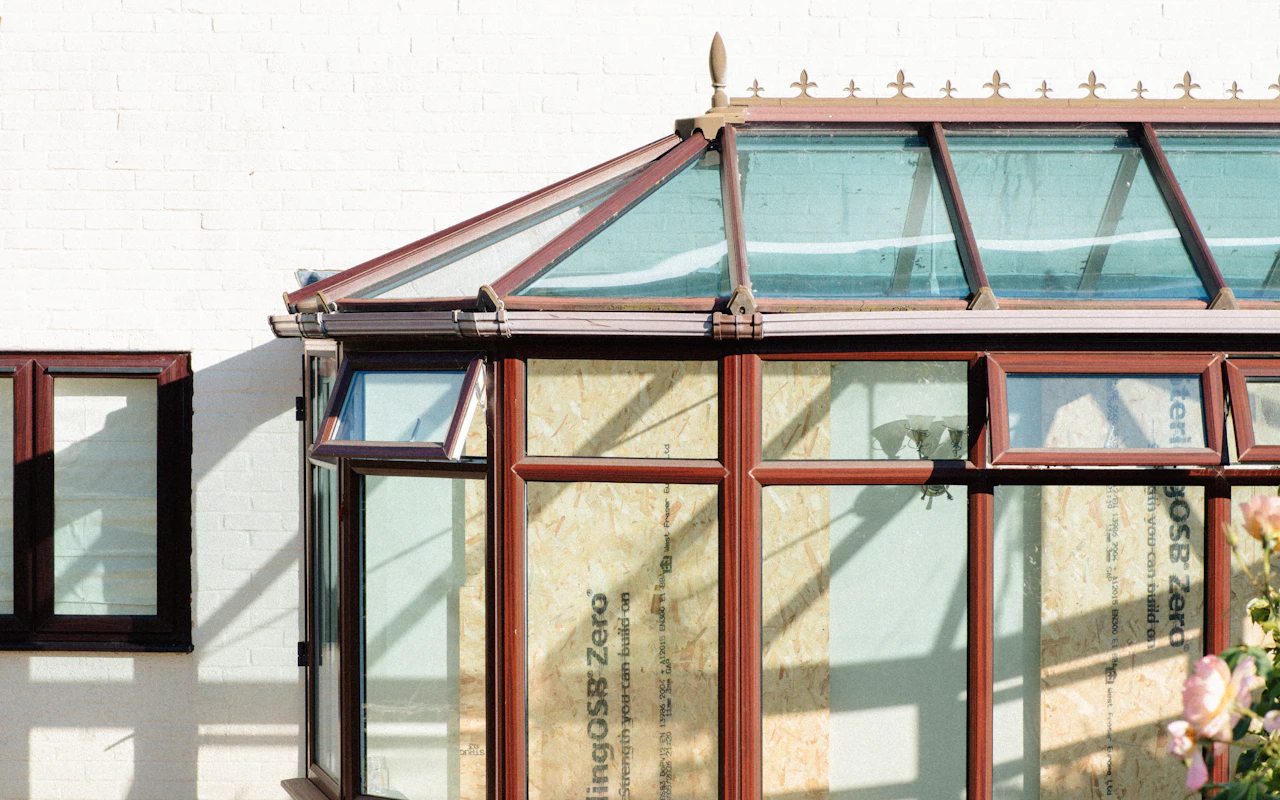
The usual shorthand goes: tiles if you are cold, glass if you want sunshine. Fair enough as far as it goes, yet the frame underneath, the direction the room faces and how you plan to use it can each flip that choice.
Is the conservatory a winter sitting room or a summer room you shut up in October? Hold on to that answer as you read.
Tiled warm roof
Sold as a solid roof or a warm roof, this swaps the glazing for an insulated timber build: tiles on top, a smooth plastered finish underneath. Done well, the room you avoid every January becomes one you actually sit in.
Why people choose it
The reasons that come up most often:
- Holds heat in winter and keeps out the worst of the summer sun
- Quiet when it rains, which matters on a wet Tyneside afternoon
- Looks more like part of the house from the street and the garden
- Room for ceiling lights, and a lantern if you want sky overhead
The trade-offs
And the points that make some people think twice:
- The dearest option, and the one most likely to need frame work
- Usually needs Building Regulations approval, so allow for the paperwork
- Less daylight, which you will notice in a north-facing room
Glass roof
A new glass roof uses sealed double-glazed units, usually with a coating that bounces some of the sun’s heat back out. It keeps the bright, open feel that made people buy conservatories in the first place.
Why people choose it
The reasons that come up most often:
- The most light of any option, even under a grey sky
- Coated glass handles heat and glare better than older roofs
- Lighter than tiles, so frames rarely need much strengthening
The trade-offs
And the points that make some people think twice:
- Still warmer in summer and cooler in winter than a tiled roof
- Costs more than polycarbonate for a similar size
- Needs cleaning to stay clear, and moss can gather at the gutters
Polycarbonate sheets
Polycarbonate is the ribbed plastic sheeting found on a lot of older conservatories. Swapping it for new, thicker multiwall sheets is the lowest-cost answer to leaks, yellowing and perished seals.
Why people choose it
The reasons that come up most often:
- Lowest outlay of the three, and often the shortest job
- Very light, so it works on almost any sound frame
- New sheets are clearer and better insulated than tired old ones
The trade-offs
And the points that make some people think twice:
- Rain drums on it, which some people never get used to
- Weakest at holding heat in, so winter use stays limited
- Tends to dull and discolour again over the years
The three side by side
This is a rough comparison in general terms. The exact product, the room's direction and how well it is fitted all shift the picture.
| What matters | Tiled | Glass | Polycarbonate |
|---|
| Daylight | Low, unless you add a lantern | High | High, a little diffused |
| Warmth in winter | Best of the three | Middle | Least |
| Summer heat | Stays coolest | Better with coated glass | Can get very hot |
| Rain noise | Quiet | Fairly quiet | Loud |
| Weight on the frame | Heaviest | Medium | Lightest |
| How long it lasts | Longest, like a house roof | Long, if the seals hold | Shortest |
Prices follow the same order as the weight. You can see the full bands on the conservatory roof prices page.
Will the frame carry tiles?
Plenty of jobs hinge on this. Glazed and poly roofs are light, and your frame was designed around a light load. Rafters, tiles and plaster bring a lot more weight, and every kilo of it ends up bearing on the frame and base.
A careful fitter will check a few things before quoting for a tiled roof:
- The ring beam. This is the rail along the top of the frame that the roof sits on. It may need a stronger replacement.
- The frame posts and doors. Wide door openings and slim uPVC posts may need steel or extra posts to carry the load.
- The base and walls. Dwarf walls and foundations built for a light roof are looked at, because building control will ask about them too.
If a firm quotes for tiles without looking at any of this, treat that as a warning sign. The building rules page explains why the council takes an interest.
Which roof suits Newcastle houses
There is no single Newcastle house, so there is no single right roof. What you can do is match the roof to the building it is attached to.
On the big Victorian houses of Jesmond, built in sandstone, buff brick or red brick, a tiled roof in a colour close to the main roof tends to look as if it was always meant to be there. South Jesmond is one of the city's 12 conservation areas, along with Gosforth, Brandling Village, Summerhill and others, so changing how a conservatory roof looks from the street is worth raising with the council first.
On a later semi or terrace with a modest uPVC conservatory, the frame often decides it. If it is sound but light, glass or new polycarbonate keeps the weight down. If you want a room you can sit in all winter and the frame can be strengthened, a tiled warm roof is the one that changes how the room feels.